Good health underpins education, employment, and economic growth, yet 4.5 billion people still lack access to essential health services. AI offers practical solutions by expanding access through virtual triage, remote diagnostics, and clinical decision support, helping patients receive timely and appropriate care. Examples from Brazil, Ethiopia, and India show how low-cost “Small AI” tools can improve disease detection and maternal health in low-resource settings. AI can also strengthen health workers’ capacity, create jobs across the health ecosystem, and improve efficiency. However, realizing its potential requires investment, training, strong governance, privacy protections, and safeguards against bias. With responsible deployment, AI can help build stronger, more equitable health systems and expand quality care to millions.
Artificial Intelligence

Athletes increasingly treat signature celebrations—like Usain Bolt’s pose or Michael Jordan’s dunk—as valuable intellectual property, registering them as trademarks to capture their commercial identity. Trademark law can protect either motion sequences or stylized images tied to a specific person. However, generative AI now challenges this system by replicating gestures without copying original footage, blurring concepts like ownership and consumer confusion. The story from the World Intellectual Property Organization argues (WIPO) that traditional trademark frameworks may no longer suffice, suggesting a need for stronger personality or publicity rights to safeguard identity in an era of synthetic media and digital imitation.

UNCTAD warns that rising investment in AI and strategic technologies is concentrating capital in a few sectors and countries, increasing the risk that many developing economies will be left behind.

She woke to a nightmare: AI-generated sexual images of her had spread online while she slept, reaching thousands within minutes. For many women and girls, this is now an everyday reality. Deepfakes are overwhelmingly weaponized against women, often pornographic and non-consensual. Once shared, they spread rapidly and are nearly impossible to remove, causing lasting harm. Accountability remains weak: laws lag, enforcement is inconsistent, and platforms respond slowly. Reporting can retraumatize survivors, while perpetrators go unpunished. Ending this abuse requires stronger laws, faster action by platforms, and better survivor support. Deepfake abuse is preventable and survivors are demanding justice.

Generative artificial intelligence is rapidly transforming workplaces across the globe, enhancing productivity and reshaping tasks in many occupations. But its effects are not gender neutral. A new report by the International Labour Organization finds that women are more exposed than men to the risks linked to this technology.
In this episode of the ILO Future of Work podcast, Anam Butt, technical specialist on gender equality and
non-discrimination at the ILO and co-author of the report, explores why women are overrepresented in jobs where tasks can be automated, why they remain underrepresented in AI and STEM occupations, and how AI systems can reproduce existing biases and stereotypes.
She also discusses how policymakers can ensure that digital transformation advances, rather than undermines, gender equality at work.

New data shows AI adoption largely follows predicted job exposure, but a widening global divide leaves high-income countries leading usage while developing economies risk technological exclusion.
Jean‑Michel Jarre narrates how AI is transforming creation and connection, and UNESCO promotes ethical frameworks to ensure technology enhances, not replaces, human creativity.

Following the appointment of forty experts to the Independent International Scientific Panel on Artificial Intelligence (AI), the UN Secretary‑General continues advancing the global AI agenda by participating at the India AI Impact Summit 2026 (18–20 February, New Delhi). The Summit focuses on how AI can benefit humanity and support inclusive growth through the pillars of People, Planet, and Progress. António Guterres took part in a high‑level session examining how scientific evidence and independent expertise can reinforce safe, trusted, and internationally coordinated AI governance.

As legal battles over AI training and copyrighted material unfold globally, the music industry faces a pivotal moment to balance innovation with fair compensation, while enabling AI’s growth.

As artificial intelligence reshapes how we create, share, and engage with information, media and information literacy (MIL) is more essential than ever. In a world where AI influences news feeds, search engines, and even content itself, MIL empowers individuals to think critically, question sources, and understand the impact of algorithms. By prioritizing human judgment, ethics, and awareness, "Minds Over AI" calls for a future where people, not machines, guide the interpretation and use of digital information.
After selecting a High-Level Advisory Body on AI and establishing a comprehensive Digital Compact, the UN continues to push the boundaries of virtual AI engagement. On 25 September, it is convening a significant High-level informal meeting to launch the Global Dialogue on Artificial Intelligence Governance. This event, part of the General Assembly High-Level Week 2025, brings together Member States, Observers, UN specialized agencies, and diverse stakeholders to explore key dimensions of inclusive and accountable AI governance and to share their expectations for the first Global Dialogue in 2026.
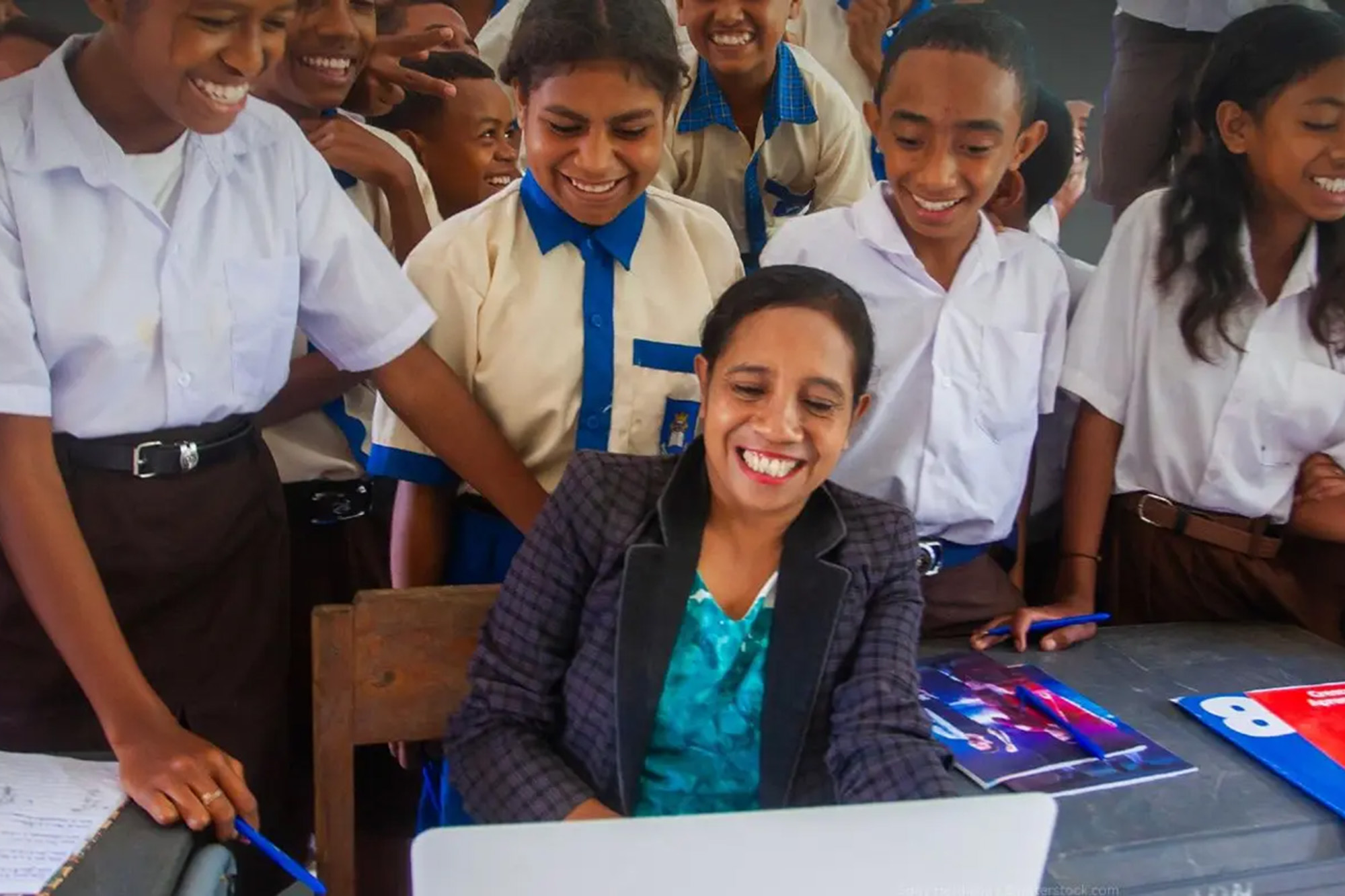
Teachers cultivate essential skills like critical thinking and emotional intelligence that machines cannot teach. However, there's a global shortage of qualified teachers, with a need for 44 million more by 2030 to meet educational goals. Digital Learning Week 2025 addresses the challenges and opportunities AI presents in education. Militza Saavedra Montero, a teacher from Chile, views AI as beneficial, having gained valuable digital competencies through UNESCO training that helps her save time in the classroom. Militza feels that her role as a teacher is essential in helping students use technology with a critical mindset. The challenge is to teach people how to use AI responsibly.